
“Follow the trend” or “go against the trend”? Why is it so important to identify trend signals?
- 2025年11月18日
- Posted by: Eagletrader
- Category: News
What type of trader are you? Do you like to follow the trend like most people in the market? Or do you dare to go against the trend and look for potential reversal opportunities? No matter which type you are, if you want to make a steady profit in the market, you are inseparable from one key ability – judging when the trend ends and when it reverses.
The trend is a friend, but not a forever friend
In the foreign exchange or other trading markets, almost everyone has heard the saying “the trend is your friend”. Going with the trend often means a higher success rate and less psychological pressure. After all, once a trend is formed, it often lasts far longer than expected – strong currencies will be stronger, and weak currencies may continue to weaken.
However, the real problem for most traders is not “whether they can see the trend”, but whether they can maintain consistency in execution during adjustments and shocks. Many people leave the market early due to emotional fluctuations or short-term corrections, and ultimately miss the main profit period of the trend.
Why some people always “chase at the end”
The reason why trends are difficult to grasp is that many traders tend to enter the market when the trend is “most exciting”. This is not a mistake, because corrections and consolidation periods do occur in trends, and you can still find good entry points as long as you choose the right position.
But the problem is: delayed entry means that profit margins are compressed, especially for short-term traders, the risk-reward ratio will quickly deteriorate. Therefore, learning to identify signals that the trend is about to reverse is not only a required course for contrarian traders, but also an important basis for traders with the trend to exit the market.
Trend reversal
There is no permanent trend in the market. Any rise or fall will eventually turn around at some point. Mastering the ability to identify reversals can not only help you find the “starting point”, but also timely stop profits at the end of the trend to avoid being trapped. In other words – identifying trend reversals is the most valuable of all trading skills.
Fundamentals: Beware of sudden “turning points”
Trend reversals are often accompanied by changes in fundamentals. Major economic data, central bank policy statements, geopolitical events… these may become triggers for trend reversal. However, the problem is: no one can know in advance when the “surprise” or “accident” will arrive.
Strong trends are often pushed up or interrupted by unexpected news. Therefore, traders need to pay close attention when important data is releasedtime and be prepared to respond at critical moments.
Technical: There is no “god indicator”, only multi-dimensional confirmation
Although technical analysis cannot provide 100% accuracy, it is still the main tool for identifying trend reversals. The simplest and most practical one is the trend line. An effective breakthrough of a trend line often means that the market may enter a new stage.
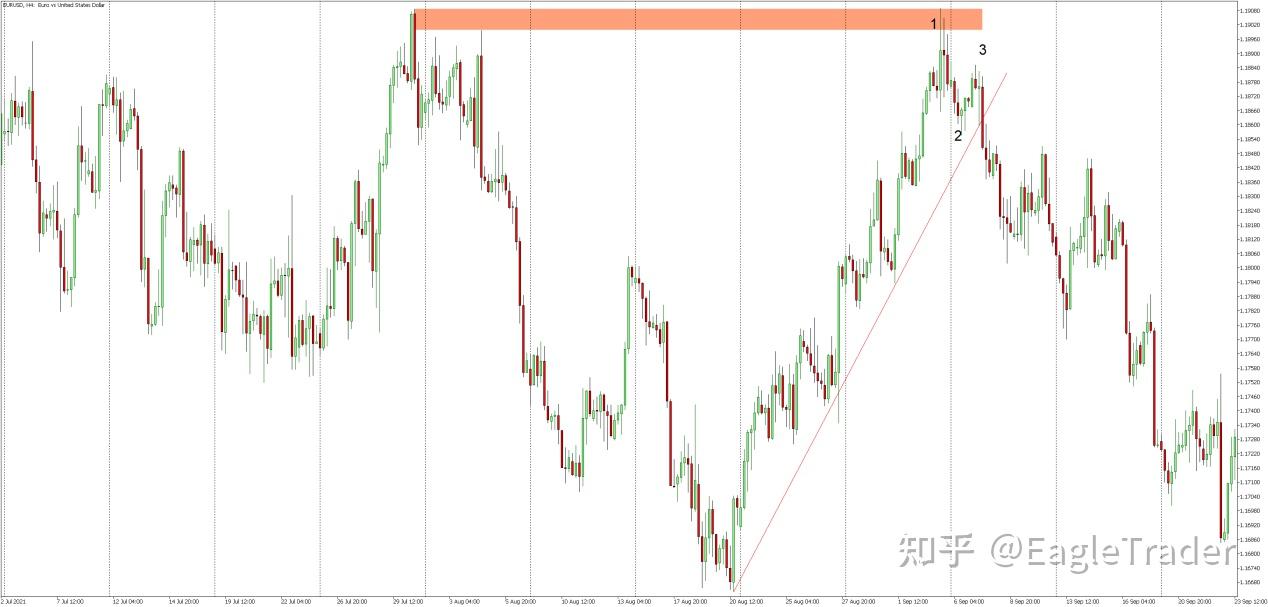
The reliability of the signal will be stronger if there is both structural confirmation (such as lower highs, 1-2-3 patterns) or a rebound from key resistance levels.
For example, in the EUR/USD chart, when the short-term trend line is broken and accompanied by obvious pattern confirmation, a subsequent trend reversal does occur. But if the trend line is pierced alone without other supporting signals, it is often just a deeper correction rather than a true reversal.
Trend lines are not drawn for your own comfort
Drawing trend lines may seem simple, but in fact it requires experience and objectivity. Many traders like to “draw a line for entry” – eager to conclude that the trend is over as soon as the trend pulls back even slightly.
For example, in the trend of USD/JPY, there seemed to be signs of reversal on the surface, but it turned out that it was just an adjustment. Premature judgment not only wastes opportunities, but can also easily lead to repeated slaps in the face. The market will not change based on your subjective expectations. Trend lines are tools, not placebos.
<img alt="" src="https://www.hudianbaoseo.cn/uploads/allimg/20251118/1763458540158269.jpg" width="654" height = 313
But no single signal should be used in isolation. The most reliable reversal signals often come from the resonance of multiple factors: technical structure + trading momentum + fundamental expectations.
Trend reversal is most easily confused with “strong adjustment”. A truly mature trader does not pursue “catching the top and buying the bottom” every time, but understands that missing an opportunity is better than falling into one.Mistakes are more cost-effective. Patience is the most expensive and scarce cost of identifying reversals. As an old saying goes: “The market will always be there, but your principal may not be able to afford it.”