
You lose money with an 80% winning rate, but you make money with a 30% winning rate? The core of trading is not the winning rate at all.
- 2026年3月31日
- Posted by: Eagletrader
- Category: News
Trading is not a game of certainty, but a game of probability. Many people spend a lot of time studying “how to improve accuracy” before entering the market, but few people really think about one question: If you are 80% right, but still lose money in the end, what is the problem?
In this article, we will break down the relationship between winning rate and risk-return ratio (RRR), and how to use them in EagleTrader challenges, to truly understand what is the core of long-term profitability.

The Cruel Reality of Trading
The reason why most novice traders fail is that they treat trading as a sprint. They took too much risk on a certain “guaranteed” trade, and when the market inevitably did something unexpected, their account would be liquidated.
Professional trading is a marathon. Your goal is not to win every trade, but to manage your losses so that profitable trades ultimately lead you to positive returns.
The balance between winning rate and risk-reward ratio
Have you ever achieved a high winning rate, but your account balance is still in the red? This is a frustrating paradox for many growing traders. The problem is the lack of synergy between the two key performance indicators.
Long-term profitability is not about how often you are “right” but rather about the mathematical balance between:
Win rate: the proportion of trades that are profitable. If you make 10 trades and 4 of them are profitable, your winning rate is 40%.
Risk-reward ratio: The relationship between potential profit and predefined risk on each trade. If you are willing to risk $100 on a trade (stop loss) and expect to make a profit of $300 (target), the risk to reward ratio is 3:1.
Math can seem a little boring sometimes, so let’s illustrate the numbers with concrete examples.
Trader A (high winning rate, low risk-reward ratio)
Trader A is more concerned about “not losing money”. To maintain a high win rate, they adopt a strategy of making small, quick profits but letting losing trades run in the hope that they will reverse.
Winning rate: 80% (8 profits and 2 losses)
Risk parameter: risk $100 to obtain a profit of $20 (profit and loss ratio 0.2:1)
The calculation is as follows:
8 profits × $20 = +160 $2 losses × $100 =
-$200 Result: Although Trader AIt was “right” 80% of the time, but they ended up with a net loss of $40.
Trader B (low winning rate, high risk-reward ratio)
Trader B regards losses as normal trading costs. They cut losses quickly but allow winning trades to fully hit their mark.
Winning rate: 30% (3 profits and 7 losses)
Risk parameters: Risk of 100 US dollars per transaction, expected return of 300 US dollars (profit and loss ratio 3:1)
The calculation is as follows:
3 profits × 300 US dollars = +900 US dollars 7 losses × 100 US dollars = -$700 Result: Despite losing money 70% of the time, Trader B ended up with a net profit of $200.
Find your “sweet spot”
You don’t have to choose extreme strategies. As a trader, your goal is to find a sustainable balance that matches your psychology. For most traders, combining a 40%-50% win rate with a 2:1 risk-reward ratio is a realistic and highly profitable basic configuration.
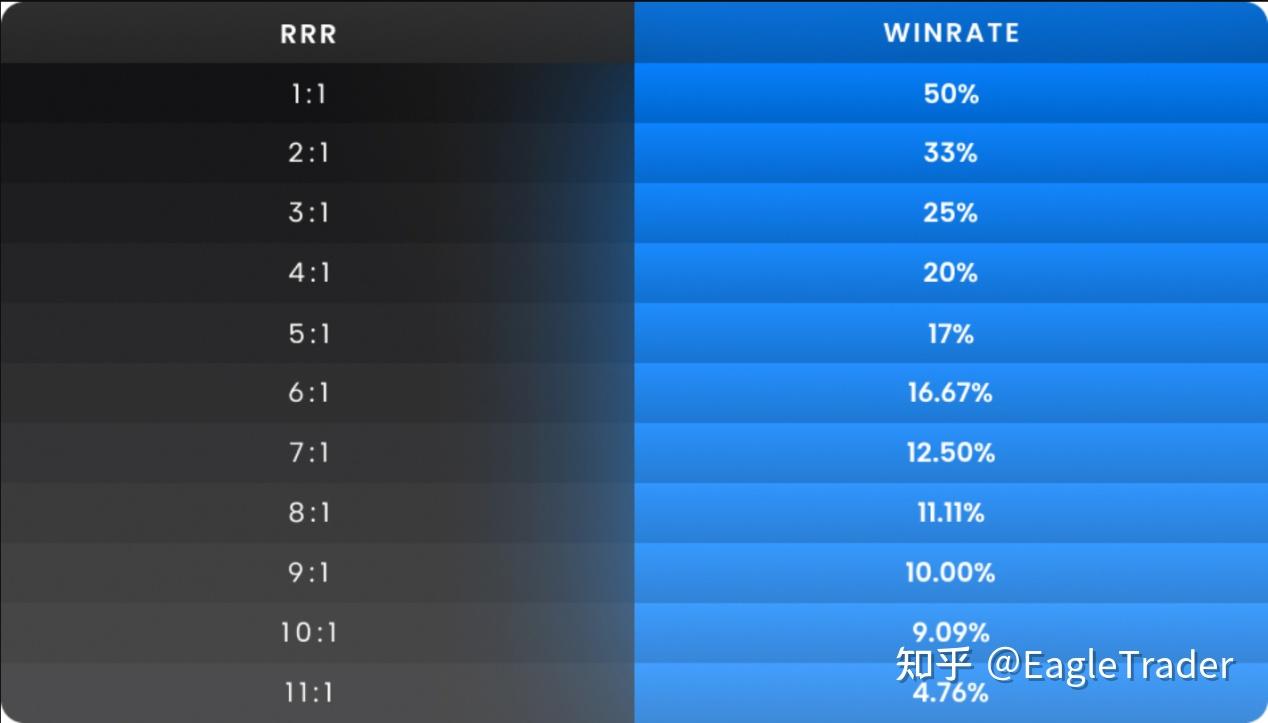
This combination can bring huge psychological advantages: even if the transaction failure rate exceeds 50%, your account will not be liquidated.
How to protect your EagleTrader challenge account?
The general rule for long-term survival is: reduce risk as much as possible. It is recommended that the risk of each transaction be controlled between 0.5% and 1%. Don’t worry, small risks don’t equal small gains – because EagleTrader Challenge Accounts offer a variety of size options, with initial capital up to $200,000, which can lead to attractive simulated returns.
There is no one-size-fits-all solution. The ideal risk value for each trade essentially depends on your specific win rate and risk-reward ratio.
In the world of trading, there is no “sure-win” formula, but there is a “sustainable” rule. The winning rate is never the talisman of profit, the profit-loss ratio is.
When you no longer obsess about “it must be right this time”, but start to care about “if I am wrong, can I bear it”, you will find that trading has changed from a gamble to a business that can be calculated and copied.
In the EagleTrader challenge, the competition is not about who can see more accurately, but who can live more steadily for a longer period of time. I hope you can find your own balance point and turn this knowledge of probability into your own advantage.