
Are you eager to equalize when you lose? Many self-operated traders fall into this rush.
- 2026年10月28日
- Posted by: Eagletrader
- Category: News
In the previous article, we compared proprietary trading to a football club: the platform is like a picky coaching staff, hoping to find truly capable players through trials, while traders are like players playing football, using their strength to fight for long-term cooperation opportunities.

But for professional players, getting the jersey and actually stepping onto the lawn is just the beginning.
The real professional arena is never a playground for laissez-faire.
No matter how talented a player is, the team must have its game discipline and tactical boundaries – because what the club needs is never someone who occasionally plays a stunning victory, but a player who can stay on the court steadily for a long time.

The retracement limit in proprietary trading is actually the same.
It is not to tie the hands of traders, but to draw a bottom line for risks: when the market is not going well and transactions are frustrated, can your account still be within the acceptable range of the platform?
Putting this logic into EagleTrader Max, those seemingly complicated risk control rules suddenly become clear.
01|Intraday retracement: Don’t mess up the whole game just because you concede a goal first.
Suppose that not long after the game started, your team conceded a goal first.What is the most dangerous thing at this time?
It was not that the score was temporarily 0:1, but that the players began to deviate from the original tactics because they were eager to equalize the score.
The defenders kept pressing forward, the offensive players rushed to shoot, and the opportunity that should have been organized patiently turned into a hasty attack.
The result is often not to recover a goal, but to lose the second and third goals in succession because the formation is completely disrupted.
The same goes for trading.The first loss of the day may not be a serious problem in itself.
What really makes the account lose control is that after a loss, you start to rush to recover, the frequency of transactions becomes higher and higher, and the positions become more and more aggressive.
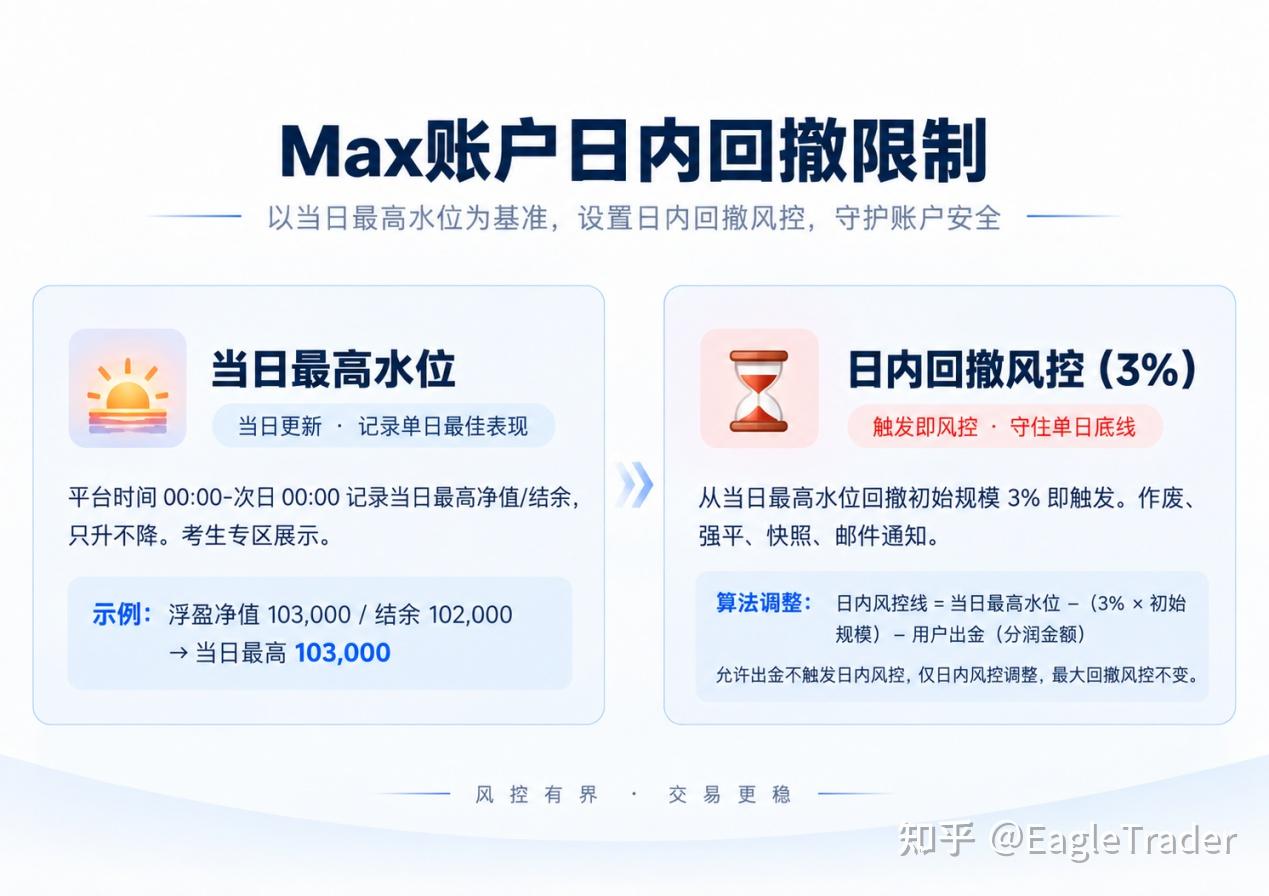
Therefore, EagleTrader Max sets a maximum intraday drawdown limit of 3%.
It is more like a risk boundary in a game: you are allowed to make mistakes today, but you are never allowed to have one failure, allowing the risk of the entire trading day to expand infinitely.
(Note: Max’s intraday risk control will also be dynamically calculated with reference to the highest water level of the account on that day. In other words, if a certain profit has been made that day and then there is a significant retracement, you need to always pay attention to how much room there is left from the intraday risk control line.)
02|Maximum account drawdown: Allow status to fluctuate, but cannot always crash the game
A player cannot be at his best every game throughout the season.
It’s normal to perform better today and be worse in the next game. The club will not deny a player just because of a mistake.
But if the performance continues to deteriorate and has exceeded the bottom line that the team can accept, the coaching staff will naturally need to re-evaluate: Can this player continue to stay on the court?
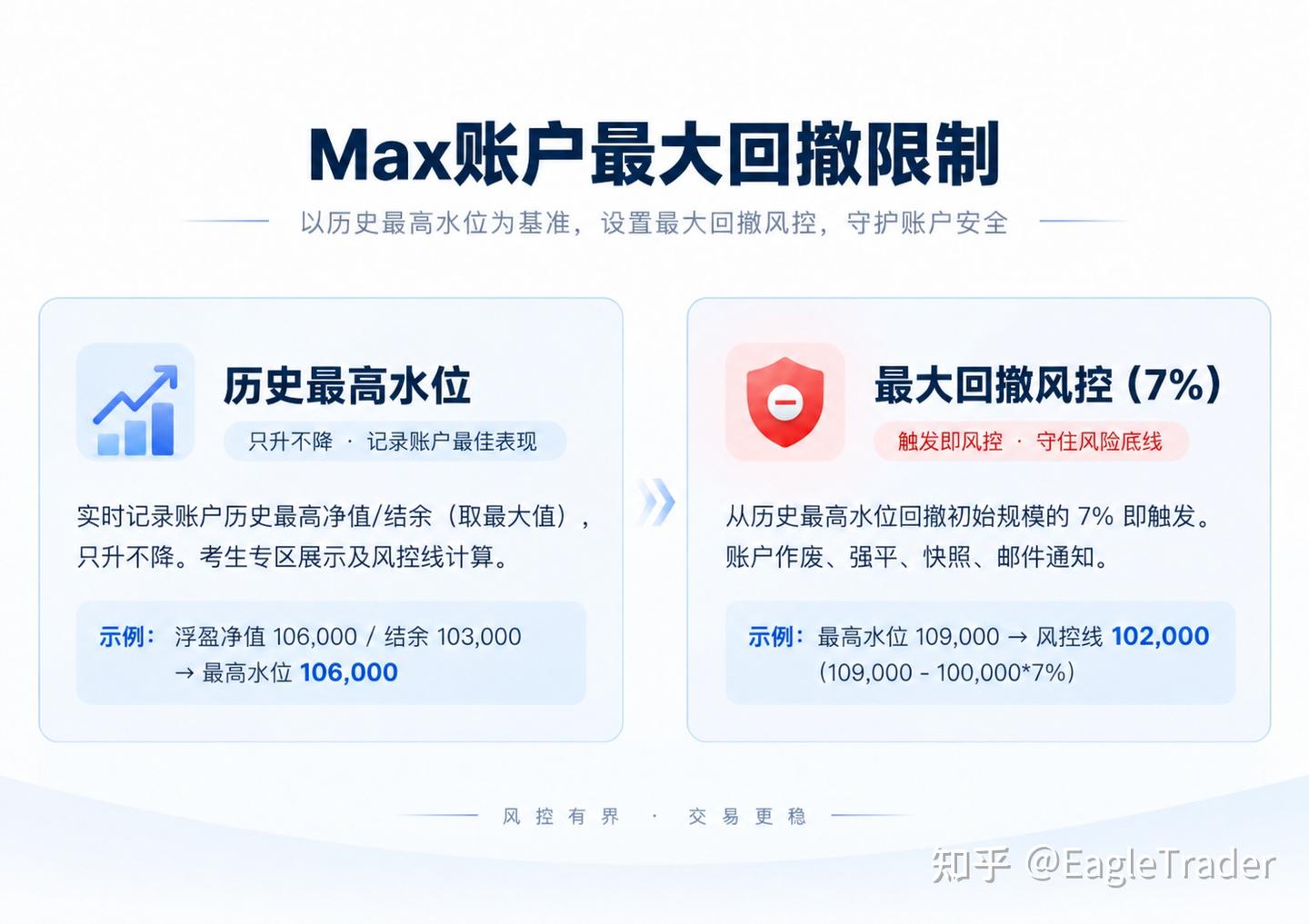
The maximum account drawdown of 7% is similar logic.What this rule focuses on is not a single transaction, but whether the risks of the entire account are effectively controlled during the continuous operation.
Traders can experience periodic retracements, but what the platform really needs to see is: when the market is not going well, you have the ability to control losses and prevent risks from continuing to expand.
03|Dynamic water level: After performance improves, new performance will become a new reference
This is the most confusing part for many people who are new to self-operated trading accounts.
Let’s continue with the football club example.When a young player first joins the team, the coach may only ask him to steadily complete basic tasks.
But if he performs well in several consecutive games and gradually becomes the main force, then the standard for evaluating him in the future will naturally not stay at “as long as he can finish the game.”

After performance improves, the new performance will become the new reference.
Max’s dynamic high-water mark mechanism does exactly that.
Suppose a $100,000 account keeps making new highs after trading for a period of time.
As the historical highest water level increases, the risk line corresponding to the maximum retracement will also be adjusted upward according to the rules.
This means: the account may still be higher than the original $100,000, but this does not mean that the risk space is still as large as when it was started.
Because the platform not only looks at how much more profit you have made than at the beginning, but also pays attention to how much the account has withdrawn from the highest position it has ever reached.
Therefore, the more your account hits a new high, the more you need to re-confirm your risk space, instead of treating the profits you get as a bargaining chip that you can squander at will.
EagleTrader Max eliminates the need for multiple rounds of preliminary profit target assessments and provides traders with a more direct path to get started.
But the club (self-operated trading platform) will never cancel the game discipline because of this – no matter how you get the opportunity to play, what ultimately determines how far a person can go is still his ability after actually entering the game.
What self-operated trading platforms are looking for is never a trader who will never lose money, just like a football club does not require players to make zero mistakes throughout the game.
What is really important is that even if the account is in the red, the trader knows where the risk should stop.
For EagleTrader Max
For traders, understanding these rules is not to carefully trade by staring at the numbers every day, but to have a clearer judgment on their risk space before actually placing an order.