
Can individual traders break through the profit bottleneck? The answer is hidden in this set of 3M rules
- 2026年4月30日
- Posted by: Eagletrader
- Category: News
When trading frequently suffers losses, many people will attribute the problem to “the strategy is not good enough”, so they keep looking for new methods.
But when you come into contact with more systematic trading training, you will gradually discover a phenomenon: truly stable traders do not change strategies frequently. They are more concerned about how to implement a set of methods for a long time.
It is also during this process that an underlying framework that has been repeatedly verified by professional traders gradually emerged – that is

Alexander
The 3M rules of trading proposed by Elder.
This set of rules comes from the classic book “Trading for a Living”. Elder summarized the core capabilities relied on for long-term stable trading into three dimensions:
Mind (trading psychology) Method (trading system) Money (fund management)
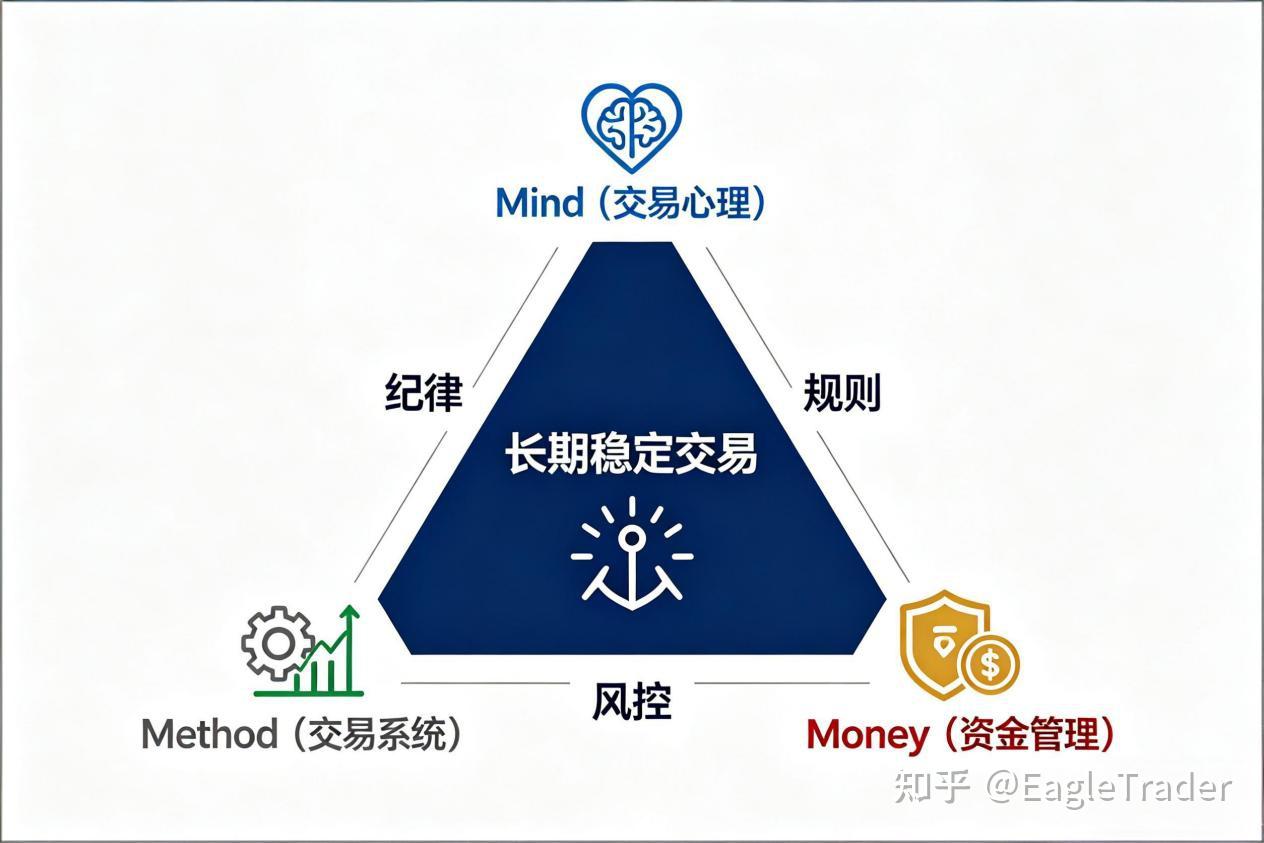
The three do not exist in isolation, but are a mutually restrictive structure. Many traders have been stuck in a bottleneck for a long time, often not because there are not enough methods, but because the investment in these three dimensions is unbalanced.
Mind: The problem lies in execution
In the 3M structure, trading psychology is given top priority, which is not accidental. The market itself is just fluctuations, but these fluctuations will continuously amplify traders’ inner emotions: greed, fear, luck, and impatience.
You may have experienced similar moments: the originally set stop loss was canceled because you were “unwilling to do so”; the profits that were already in place were given up because “it can go up again”. These seemingly small deviations are the real source of account fluctuations.
One fact that no one who trades can escape is that more than
7
of retail traders will suffer a net loss within a year, and the National Futures Association (NFA) has warned many times that frequent trading, failure to execute stop losses, and random addition of positions are the core culprits that cause the vast majority of people to lose money.
These problems appear to be operational problems, but in essence they all point to the same core – the execution cannot be implemented stably.
Method: The core is standardization
In contrast, trading methods are more likely to be overvalued.Many people are used to constantly looking for “better strategies”, but what really works is not the strategy itself, but whether it has a clear and repeatable structure.
A complete trading system usually needs to answer several basic questions:
Under what circumstances do you enter the market? Under what circumstances do you exit? Under what circumstances do you choose not to trade? Its value does not lie in predicting the market, but in making every transaction have a consistent basis for decision-making.
As Van K. Tharp, author of “The Road to Financial Freedom” has verified, long-term performance depends more on profit and loss structure and execution consistency than on pure winning rate.
Money: Survive first
If the method determines “how to do it”, then money management determines: how long you can do it. In professional trading, a widely followed principle is: the risk of a single transaction should be controlled at 1%-2% of the account funds.
This ratio seems conservative, but its significance is that even if there are continuous losses, the account still has room for repair.
In addition, rules such as controlling positions, setting maximum drawdowns, and avoiding adding positions at a loss are essentially doing the same thing: limiting the uncontrollable expansion of risks.
The problem for many traders is not that they cannot make money, but that they have lost the ability to continue participating before they have established a stable advantage.
Why is it difficult for individual traders to do it
It is not difficult to understand the 3M rule, but the difficult thing is to implement it in the long term. In reality, individual traders often face several problems:
The method lacks long-term verification, the risk control rules are easily broken by emotions, the lack of external constraints, and execution fluctuates over time. Because of this, more and more traders are beginning to realize that the bottleneck of trading is often not in cognition, but in the execution environment.
A way to put the rules into practice
In this context, proprietary trading has gradually become an option. Rather than offering some “better strategy,” it provides a more binding trading environment. By using retracement rules to limit risks, using mechanisms to reduce random operations, and using structures to help traders stick to their existing strategies.
In such an environment, trading will undergo a subtle change: it will no longer change methods frequently, but will begin to execute methods stably.
From the perspective of 3M, the structure of proprietary trading is essentially to help traders make up for the two links that are most likely to be out of balance – psychology and capital management.
EagleTrader
What EagleTrader does is precisely centered around this point: providing an execution environment that is closer to professional trading standards, allowing traders to gradually transform their existing knowledge into stable results.

Trading is easily understood as “who is better at analysis”, but what really determines the result is who can execute it more stably. The reason why the 3M rule is classic is not. It lies in the complexity, but in that it directly points out the essence of the problem.
Stability is never about finding a perfect strategy, but doing the right thing time and time again under the rules.