
ET Financial Sharing | Why regulatory license is a key consideration for traders when choosing a platform
- 2026年7月30日
- Posted by: Eagletrader
- Category: News
In the previous article, we mentioned that with the continuous development of the proprietary trading industry, more and more overseas platforms have begun to explore more standardized development paths and strengthen the foundation of platform operations by applying for relevant qualifications and improving business systems.
As the industry attaches increasing importance to compliance construction, the regulatory system has once again become an important discussion direction in the field of proprietary trading.
The financial market involves multiple business links such as fund management, transaction services, and asset management. Different countries and regions have therefore established corresponding regulatory systems to standardize the business scope and operating methods of financial institutions.
For licensed institutions, they need to meet the requirements of regulatory agencies in many aspects, including: company operating regulations; risk management systems; capital and financial requirements; information disclosure standards; and continuous compliance reviews.
Obtaining relevant licenses means that institutions need to meet the access standards set by the regulatory system and continue to comply with relevant operational requirements.
For traders, the regulatory system behind the platform can provide more reference information to help them understand the platform’s business scope, operational background and degree of standardization. Therefore, as the financial market continues to develop, regulatory capabilities have become one of the important factors in measuring the long-term operating foundation of a trading platform.
So, what are the representative regulatory agencies in the global financial market? What are the characteristics of different regulatory systems?
Main regulatory systems worthy of attention in the global financial market
Different countries and regions have their own financial regulatory systems, and some of them have received more attention globally due to their market influence and regulatory maturity.
UK FCA: an important regulatory system for mature financial markets
UK Financial Conduct Authority (Financial Conduct Authority)
Authority (FCA) is one of the UK’s major financial regulators, responsible for supervising the financial services industry, covering many areas such as financial institution operations, investment services, market conduct, and consumer protection. Financial institutions regulated by the FCA generally need to meet operational specifications in terms of risk management, business transparency and customer protection. Due to the high degree of internationalization of the British financial market, the FCA regulatory system has also received widespread attention from the global financial industry.
The U.S. CFTC and NFA: market regulations under a strict regulatory system
The U.S. Commodity Futures Trading Commission (CFTC) and the U.S. National Futures Association (National Futures Association)
Futures
Association, NFA) together constitute the core regulatory system of the U.S. futures and derivatives market. Among them, the CFTC is responsible for market supervision, and the NFA is responsible for industry self-discipline management. Relying on the huge market scale, this system has set clear requirements in terms of market participant registration, business operations and risk control, making it a very representative regulatory framework in the global derivatives market.
Australian ASIC: an important financial regulator in the Asia-Pacific region
Australian Securities and Investments
Commission (ASIC) is responsible for supervising the Australian financial market, covering financial services companies, investment products and market behaviors, and puts forward corresponding requirements for the operational standardization of financial institutions. Due to Australia’s close connection with the Asia-Pacific financial market, the ASIC regulatory system has also attracted the attention of financial institutions in Asia.
Hong Kong SFC: an important regulatory system connecting the international financial market
The Hong Kong Securities and Futures Commission (Securities and Futures
Commission (SFC) is one of Hong Kong’s major financial regulatory agencies. As an international financial center, Hong Kong has a mature financial market system. The SFC is mainly responsible for supervising securities, futures and related financial activities. With its unique position connecting the international and Asian markets, the SFC regulatory system has become the compliance foundation of many financial institutions serving the Asian market.
EagleTrader: Its licensed entities hold Hong Kong SFC Type 4 and Type 9 licenses
As the global financial industry gradually attaches importance to standardized development, whether the platform has a sound regulatory basis has also become an important reference for traders when choosing a service platform.
EagleTrader is headquartered in Hong Kong, and its controlling shareholder is Eagle Trader Fintech Limited registered in the British Virgin Islands (BVI).
The core entities of the group include Eagle Trader Asset Management Limited (Eagle Quantitative Asset Management Co., Ltd.) and Eagle Trader
Limited, respectively responsible for the construction of asset management systems and the research and development of financial technology capabilities.
Among them, Eagle Trader Asset Management
Limited (Eagle Quantitative Asset Management Co., Ltd.) holds certificates issued by the Hong Kong Securities and Futures Commission (SFC):
Category 4 (providing advice on securities); Category 9 (providing asset management). Regulated Activities License (License No.: BHO336).
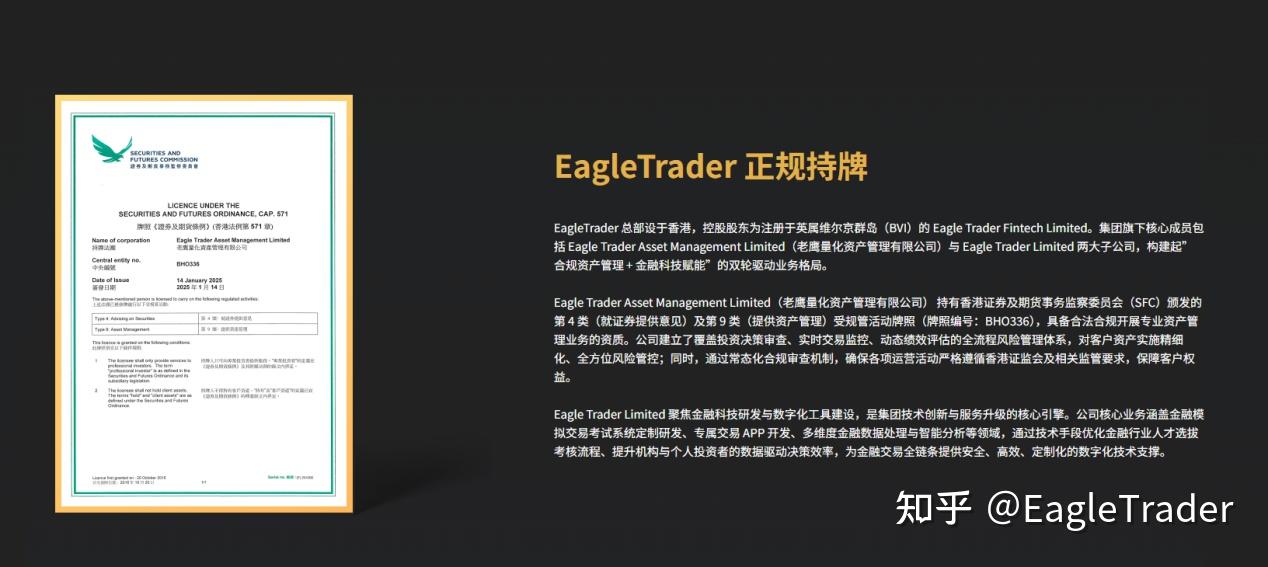
Relying on Hong Kong’s financial regulatory system, the company has established a risk management system covering investment decision review, transaction monitoring and performance evaluation, and improved the standardization of business operations through a continuous compliance review mechanism.
At the same time, Eagle Trader
Limited focuses on financial technology research and development and digital tool construction, and provides technical support for platform operations through trading systems, data processing and intelligent analysis capabilities.
Through the combination of compliance system construction and financial technology capabilities, EagleTrader continues to improve the platform operation foundation and provide traders with a more transparent, stable and efficient service experience.
As the proprietary trading industry continues to develop, traders’ focus on the platform is also expanding.
Account size, assessment rules and revenue model are still important considerations, and the regulatory system, operational capabilities and long-term development foundation behind the platform are also worthy of attention.