
Get rid of market lag! HMA Hull Moving Average helps you identify market trend changes
- 2026年7月6日
- Posted by: Eagletrader
- Category: News
Technical indicators emerge in endlessly, but not many can truly stay in traders’ trading systems for a long time.
In EagleTrader’s view, no indicator is the key to profitability. Their real value lies in helping traders observe the market more objectively, verify trading logic, and continuously improve their trading systems.
Therefore, we also hope to share with you some analysis tools commonly used by proprietary traders to help you understand the application ideas behind different indicators. Today, we will start with an indicator that has attracted more and more attention from trend traders in recent years-HMA (Hull
Moving Average, Hull Moving Average) starts.
Why do so many traders start to pay attention to HMA?
For most traders, moving averages (MA, EMA) are not unfamiliar. It can help traders judge market trends, but there is also a common problem – hysteresis.
The longer the moving average period, the more stable the trend judgment, but the response is often slower; the shorter the period, the more susceptible it is to market noise and frequent false signals.
HMA was born under this background.
It is based on the weighted moving average (WMA), and uses a special calculation method to keep the moving average relatively smooth while reducing the lag as much as possible. Therefore, many trend traders will use HMA to observe changes in market trends faster.
Of course, this does not mean that HMA can predict the market, but that it can reflect the market rhythm in a more timely manner.
What does HMA mainly look at?
Compared with traditional moving averages, which pay more attention to moving average crossovers, HMA is more often used to observe changes in the direction of the moving average itself.
For example, when the HMA turns from bottom to top, it often means that the market trend may be getting stronger; when the HMA turns from top to bottom, it may mean that the market trend is getting weaker.
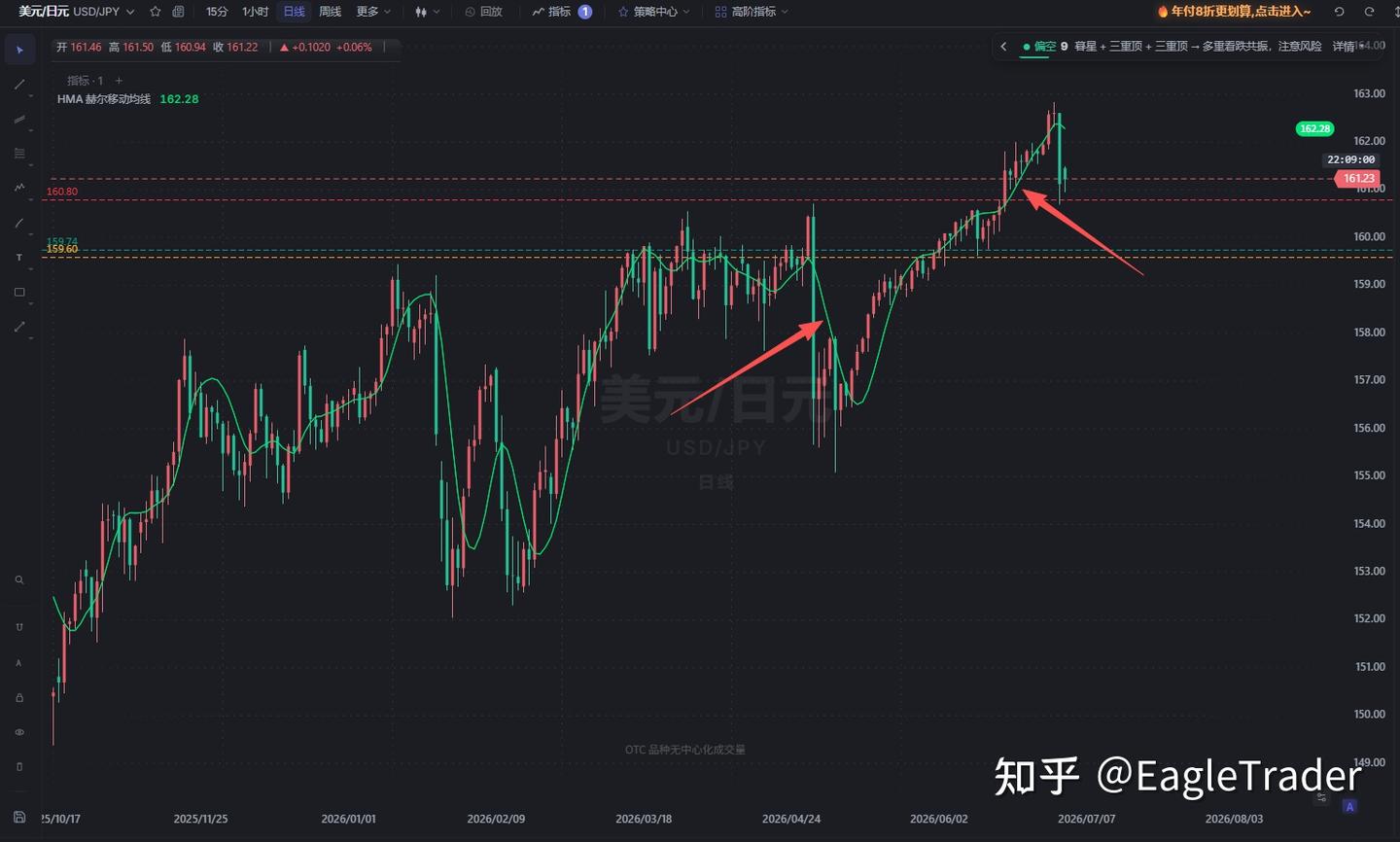
It should be noted that this does not mean that the market has definitely reversed.
HMA provides a reference for trend changes, rather than a deterministic trading signal. Mature traders usually also combine price results withMake comprehensive judgments based on factors such as structures, key support and resistance levels, and K-line patterns, rather than relying solely on one moving average to decide a transaction.
Why do many trend traders like to use HMA?
HMA is popular not because it is “more amazing”, but because it has several obvious characteristics.
First, it can reflect trend changes faster.
Compared with traditional moving averages, HMA responds faster to price changes, helping traders detect changes in market rhythm earlier.
Secondly, it can reduce the interference caused by some short-term fluctuations.
Although no indicator can completely filter out market noise, after smoothing, the trend of HMA is usually smoother than that of short-period moving averages, which has certain advantages for trend observation.
In addition, HMA can also be used as a dynamic reference line in the trend. In an upward trend, the price rebounds from the HMA and then strengthens again; in a downward trend, the price rebounds from the HMA and then falls again. These are the positions that many trend traders focus on.
Is HMA definitely better than EMA?
The answer is no. In fact, there is no “best indicator” that applies to all markets.
The advantages of HMA are mainly reflected in the trend market. When the market enters a volatile range, since the direction of the moving average is prone to frequent changes, more interference signals may be generated.
Therefore, truly mature traders rarely rely on a single indicator for trading. Instead, they use HMA in conjunction with risk management, trading plans and other analysis tools to jointly build their own trading system.
After all, indicators are only tools to assist in judging the market, not answers to substitute trading decisions.
For traders, it is not difficult to learn a new indicator. The real difficulty is to understand what market it is suitable for, what its limitations are, and how to combine it with your own trading methods.
This is also the concept that EagleTrader has always advocated. Growth is never about mastering more indicators, but about constantly verifying your own trading logic, establishing stable trading habits, and continuing to improve your own trading system.