
How to control emotional trading? Many traders have made these 4 common mistakes
- 2026年10月15日
- Posted by: Eagletrader
- Category: News
When many traders encounter problems, their first reaction is: Is their strategy not good enough?
But sometimes, the problem is not the strategy itself, but that when it is most necessary to execute the plan, people are led astray by their emotions.
I had originally set a stop loss, but started to hesitate after seeing the loss expand;
I have just lost a sum and immediately want to make it back through the next sum;
The market has gone far, but I still worry about missing out and temporarily catch up.
The trading plan has not changed, only the people executing the plan have changed.
Once emotions get involved, the originally reasonable trading logic may slowly deform during on-the-spot operations.

01|I just lost a sum and want to make it back right away
The urge to “quickly make the next deal” after a loss is a very typical revenge transaction.
At this time, traders are no longer concerned about whether there are suitable opportunities in front of them, but hope to get back the profits they just lost as soon as possible.
The entry conditions that were originally not good enough start to be interpreted by themselves as “almost doable”, and the position may be enlarged accordingly.
A very obvious signal is: you have clearly reached the loss range you set, but you are still thinking in your mind – “Stop if you make another one.”
The next trade also begins to bear the emotions left over from the previous loss.
02|The market has gone far, but I am still afraid of missing out.
Another common state is FOMO, or “fear of missing out.”
Originally I didn’t wait for my entry conditions, but seeing the price going further and further away, I began to feel a sense of urgency in my heart: If I don’t get on the bus, this market situation may really have nothing to do with me.
So the original standards were relaxed little by little.
What really needs to be vigilant is not just “chasing high” or “chasing short” itself, but when the price has significantly deviated from the original planned position, the risk-return relationship has often changed.
If the only reason for a deal is “I don’t want to miss it,” it’s worth taking a second look at your plan.
03|Reluctant to leave after losses, but unable to hold on to profits
Some emotional trades are less intense and more common.
For example, if a loss-making position has reached the original stop-loss position, traders will tell themselves that “it may just be a correction”; if a profit-making position has not reached the planned target, they exit early because they are worried about profit taking.
Behavioral finance calls this tendency the Disposition Effect: People are more likely to cash out profits too early, but are reluctant to recognize losses.
Relevant studies have found that this behavior is not only seen among ordinary traders, but can also be observed among professional investment managers, and may have an impact on long-term performance.
04|After continuous profits, the rules began to become looser
If several consecutive transactions go smoothly, your self-confidence will easily rise accordingly.
The original entry conditions that must be met start to feel like “it doesn’t matter if it’s almost”, and the position may be larger than usual.
The problem is that the trading patterns that have worked recently do not mean that the current market environment will continue forever.
Many times, the test of continuous profits is not the ability to judge, but whether the original risk standards have changed due to recent results.
If the main reason for increasing the position is just “recently doing well,” that is already a signal worth paying attention to.
Why are emotions more likely to be amplified when it comes to your own money?
Taken together, emotional trading is always affected by the loss and profit of trading funds, so this is not just a simple “bad mentality”.
When floating losses continue to expand, people’s perception of risks will change, and it is easier to focus on how to get rid of the current discomfort as soon as possible, rather than continuing to execute the original plan.
Under this kind of pressure, on-the-spot judgment is also more easily affected by instinctive reactions.
This feeling is even more concrete if the transaction uses personal savings directly.
Losses in your account may bring to mind living expenses, savings plans and even personal financial security.
At this time, a stop loss is no longer just a normal result in the trading plan, but may be understood as “you really have less money.”
Even if you know what to do, it can become more difficult to execute.
This is one of the reasons why the proprietary trading model has gradually attracted the attention of traders in recent years.
Use Proprietary Trading to Suppress Emotional Trading
Proprietary trading does not automatically make fear, anxiety, or greed go away.
However, by participating in a simulated trading account, the psychological pressure caused by personal funds directly facing transaction losses can be reduced to a certain extent.
At the same time, the assessment objectives and risk rules set by the platform add an external constraint to trading behavior.
When traders want to continue to increase risks after losing money, they need to first consider the retracement boundary of the account; if they originally wanted to change their plans due to emotions, they have to consider whether this operation will affect subsequent assessments and account performance.
To some extent, rules force traders to regain consciousness when their emotions are at their strongest.
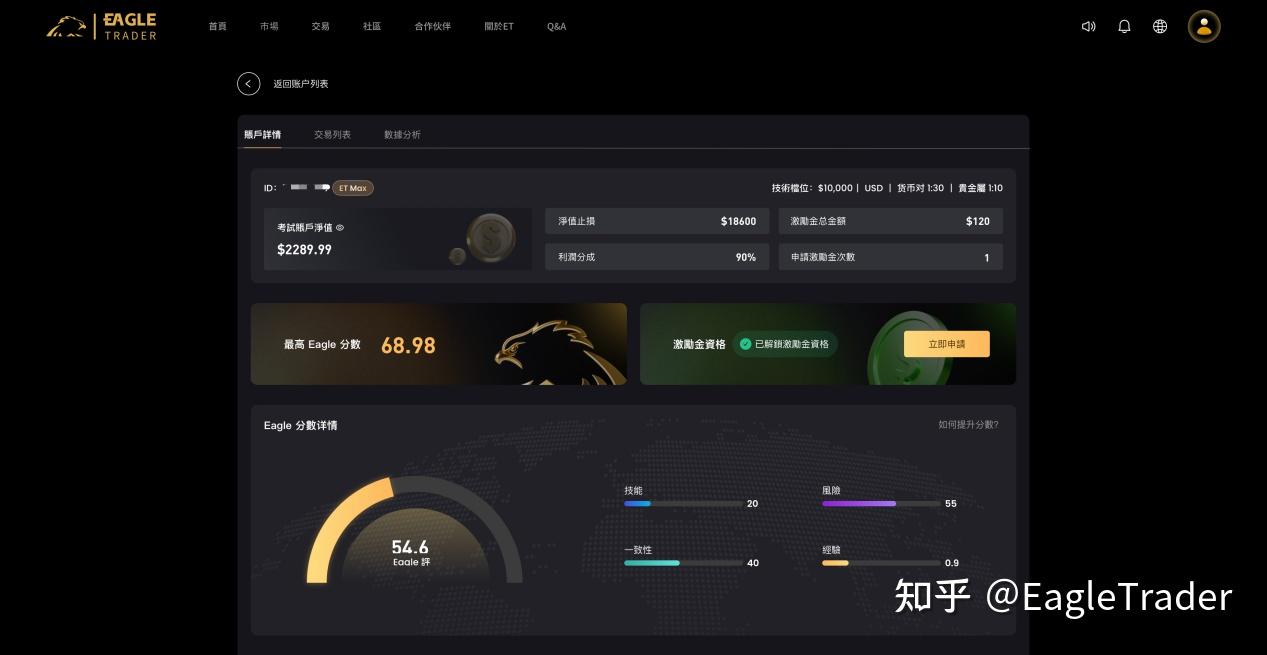
EagleTrader also continuously records trading performance through Eagle scores, providing data feedback from dimensions such as professional skills, risk management, trading consistency and trading experience.
Some issues that could only be judged based on feelings in the past now have a clearer reference.
These mechanisms cannot control emotions for traders, but they can reduce the possibility that an impulse will continue to amplify and eventually evolve into out-of-control operations.
Truly effective trading discipline never relies on on-the-spot restraint, but rather on writing the rules in front of you.
Making plans in advance, clarifying risk boundaries, and replacing subjective will with objective constraints is far more practical than worrying about it afterwards.To reduce emotional interference, you actually need external support – a clear written plan, a review log, or a set of insurmountable risk control rules.
This is what EagleTrader has been doing: providing you with a standardized and rational trading environment with its own boundaries.
Allow emotion to occur, but don’t let it dominate your next trade.Leaving room for the rules to intervene is often a key step in keeping your account.