
Is it difficult to pass the self-employed exam? Mastering these 3 fund management skills is the secret to passing the test as a trader
- 2026年6月11日
- Posted by: Eagletrader
- Category: News
In the trading market, the history of countless liquidations and tears proves: it is never the winning rate that determines how far you can go, but your fund management (risk control management) ability. If risk control management is the “braking system” that protects your account from falling into the abyss, then fund management is the “steering wheel” that accurately calculates how much troops should be placed for each order. Today, we will break down 3 core money management skills used by professional traders.
Technique 1: Fund Allocation
The trading opportunities in the market are almost unlimited. Whether it’s forex, commodities, stock indices or cryptocurrencies, there’s always something going on. But what limits the upper limit of a trader’s profit is always the limited available margin.
For most traders with a small initial capital, if they dabble in too many varieties at the same time, the result will only be excessive diversification of funds, and they will not be able to establish an advantageous position size in any single market.
The correct approach: Establish a system at the asset allocation level to clearly allocate total funds to specific markets based on the strategy’s winning rate. Specific case: Assume the total account assets are US$10,000. After back-testing historical data, the trader decided to focus funds on foreign exchange and commodities, and allocated the total principal in half in equal proportions – US$5,000 for the foreign exchange strategy and US$5,000 for the commodity strategy. In this way, capital isolation among multiple varieties is achieved. Tip 2: Position size
Fund allocation is to determine the weight of large categories of assets, while position size management is to determine how many lots should be opened for a single specific transaction. Its core purpose is to control the risk of a single transaction within an absolute tolerable range.
Well-known trader Linda Raschke once mentioned that she personally prefers to use a fixed standard lot or contract size in each transaction. This kind of quantitative operation can help traders eliminate the interference of subjective emotions and strictly limit the risk exposure of a single transaction.
Specific case: Continuing the above case, with a US$5,000 limit in the foreign exchange account, the trader plans to allocate three currency pairs. He can decide to allocate trading quotas of $1,000 each to EUR/USD, USD/JPY, and USD/CAD. Core iron rule: The position size for each transaction must be calculated in advance before opening a position, and it is strictly prohibited to temporarily add positions or heavy positions without a trading plan.
<img alt="" src="https://www.hudianbaoseo.cn/uploads/allimg/20260611/1781145269131050.jpg" width="654" height = 436 Within the preset absolute value.
Setting a stop loss means that traders accept the objective fact that “any strategy has a probability of error” on a rational level, and proactively reserve room for trial and error. In today’s trading platforms, stop losses are automatically and ruthlessly executed by system instructions, which can effectively avoid the expansion of losses due to mental hesitation.
How to feel at ease in trading. Practice capital management skills?
These capital management rules may seem simple, but in real trading, traders are often affected by the psychological pressure of real money, leading to deformation of risk control, the behavior of holding orders or blindly locking positions. If you want to perfectly practice and solidify these three techniques, the most ideal choice is to take the EagleTrader (ET) proprietary trading exam.
In the simulated real-market environment provided by ET, you can not only experience real market liquidity that is highly close to the institutional level, and accurately test your own capital allocation and stop-loss strategies; you can also conduct high-frequency trading with zero capital burden, completely transforming scientific position calculations into instinctive trading habits.
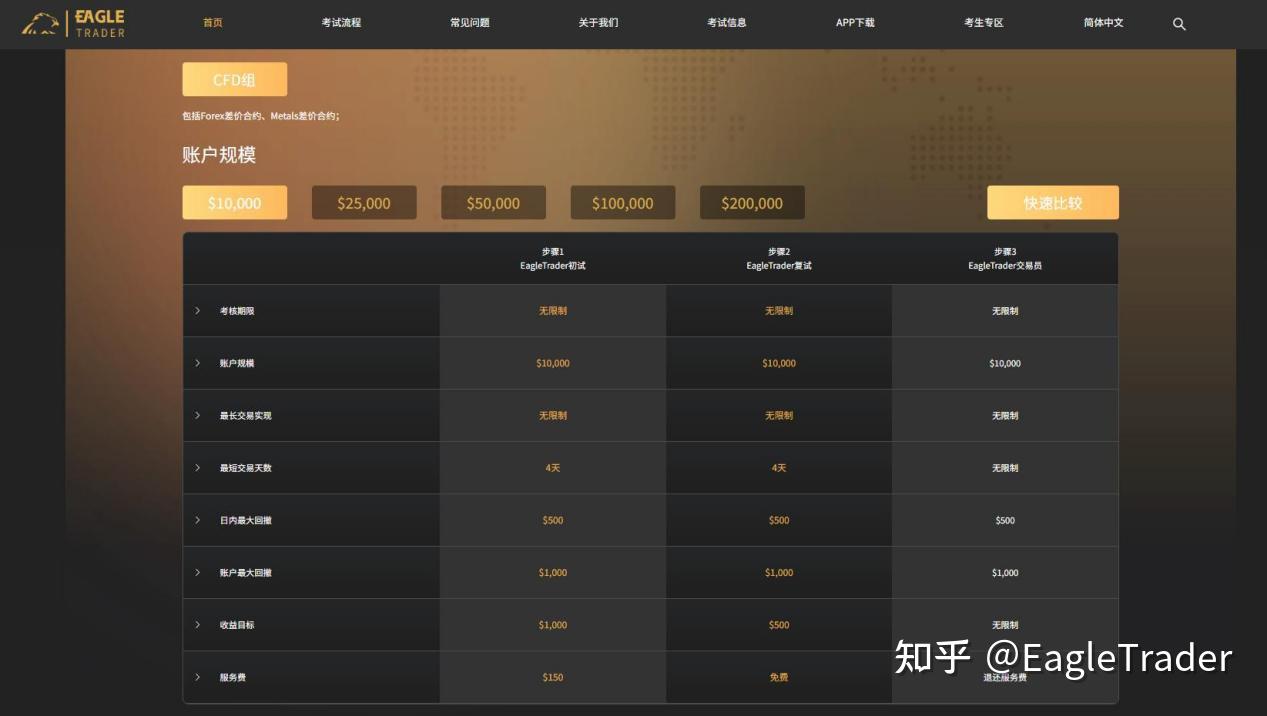
More importantly, the core assessment indicators of the ET self-operated examination are daily maximum loss control (DailyDrawdown) and overall drawdown management (Ma xDrawdown), which completely coincides with the above-mentioned fund management skills. Once you pass the assessment, the platform will also provide you with tens of thousands or even hundreds of thousands of dollars in simulated trading funds to help you officially start your professional trader career.