
Why does the price go back up as soon as you stop the loss? What traders should know about Stop Hunt
- 2026年8月18日
- Posted by: Eagletrader
- Category: News
Have you ever encountered this scenario when trading: shorting near the previous high, setting the stop loss above the previous high, and the price just broke through the previous high and triggering the stop loss, but the market immediately turned around and fell; or going long near the previous low, and after the price broke through the previous low and the stop loss left the market, the market quickly pulled back.
After several similar experiences, many traders will have questions: Is the market “targeting” me?
This seemingly “precise stop loss” phenomenon has a special concept in trading – Stop Hunt.
Many people will interpret this as a malicious operation by “institutions specifically hunting down retail investors”, but in essence, this is an objective market phenomenon caused by the inability of the market to continue after orders in key liquidity areas are triggered intensively. It is not a subjective behavior directed at a certain group of traders.
Stop How was Hunt formed?
To understand the core of loss sweeping, you must first understand the fact that stop-loss orders in the market are not randomly distributed, but will be concentrated near recognized key prices.
Take EUR/USD as an example. If the current previous high is an integer of 1.1000: traders who are short below the previous high will usually place their stop loss above 1.1000 (the stop loss of short orders requires buying to close the position, so it reflects the buy stop loss order); while other traders will regard 1.1000 as the breakthrough level, and wait for the breakthrough to enter the long position, which is a breakthrough buy order.
At this time, a large amount of buy order liquidity will gather above 1.1000. When the price touches this price upward, concentrated orders are triggered in batches, which will push the price to a rapid rise in the short term; however, if there is no continued buying, the price will be unable to maintain a high level, and will fall back below 1.1000, or even fall rapidly in the opposite direction.
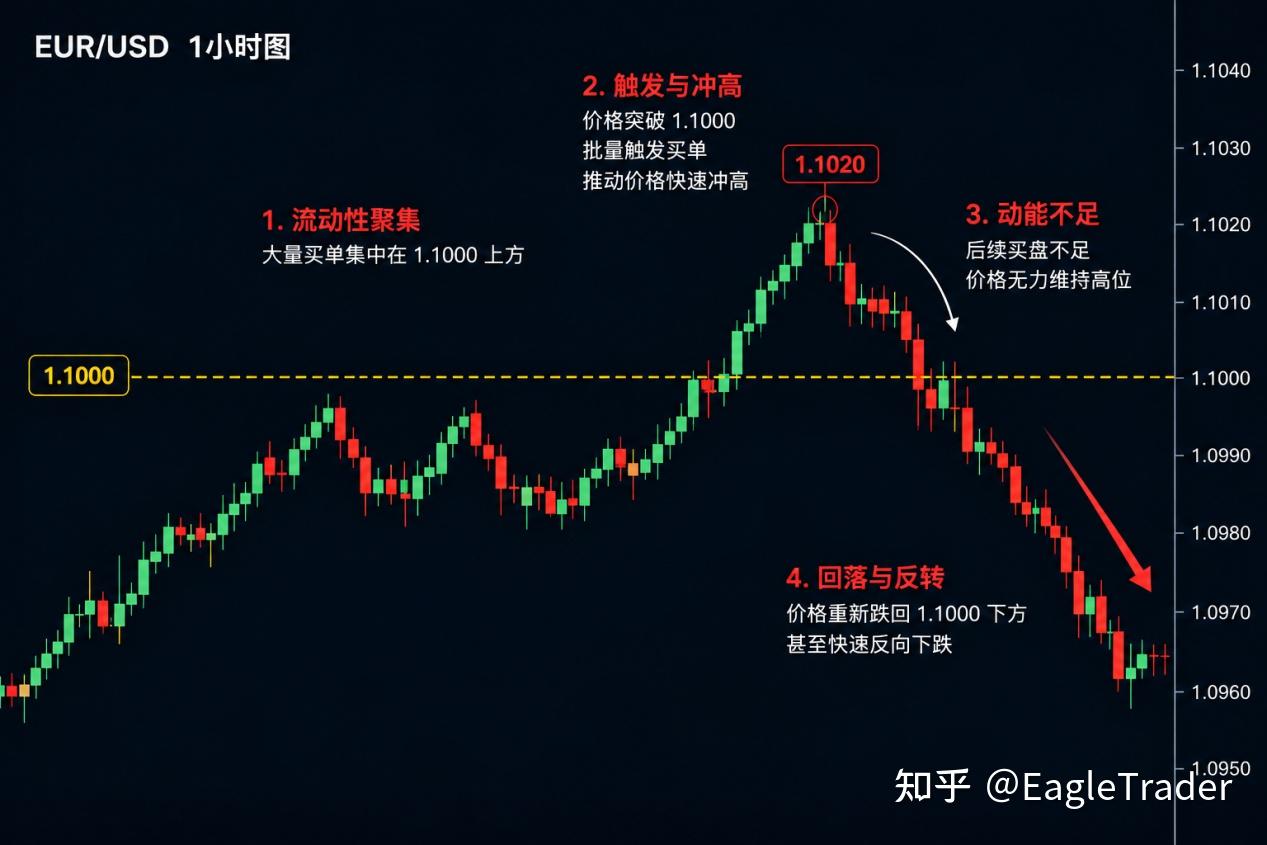
Simply speaking, the complete path of loss sweeping is: Gather liquidity at key prices → Price breakthrough triggers concentrated orders → lack of follow-up momentum → price falls back to the original range.
This is why many traders feel that “the market reverses as soon as the stop loss is swept” – it is not the market that is staring at your order, but your stop loss position, which happens to be the area with the highest concentration of orders in the entire market.
Which locations are most likely to cause S?top Hunt?
The essence of loss sweeping is the concentrated release of liquidity, so the first step in judgment is to find the key position where market orders are most likely to gather. There are four most common categories:
Historical high and previous low
The most typical liquidity areas. It is easy to gather short stop loss and breakthrough buy orders above the previous high, and it is easy to gather long stop loss and breakthrough sell orders below the previous low, which is the position with the highest loss sweep.
Yesterday’s high and low points
It is watched by the vast majority of intraday traders and is an important reference level for intraday trading. Prices often test yesterday’s high and low points before moving out of the intraday direction.
The high and low points of the Asian trading session
are especially obvious in the foreign exchange market. After the opening of the London session, capital liquidity increases significantly, and the price often breaks through the shock range of the Asian session first, and then moves out of the true trend of the day after completing the loss sweep.
The edge of the shock range that has been repeatedly tested
The more times a price is tested, the higher the market attention, and the more stop-loss and breakthrough orders are placed around this position. Once a price is broken through, it is easy to form a concentrated release of orders.
What needs to be made clear is: the key position is only the prerequisite for the occurrence of sweep loss, not that the price touch will definitely cause the sweep loss.
Judge the core of loss sweeping
This is the most easily misused point of loss sweeping strategy. When many traders see that the previous high has been pierced, they default to “sweeping losses” and immediately enter the market in the opposite direction. As a result, they often hit the real trend breakthrough.
The core difference between the two lies in the price behavior after the breakthrough:
If the price stabilizes at the key level after the breakthrough, fails to break through, and reaches new highs, this is an effective breakthrough, and the probability of the subsequent trend continuing is higher; if after the breakthrough, the price only rushes high quickly, is unable to maintain, and quickly falls back below the key price, it is a sweep loss pattern in which the breakthrough fails.
Still in EUR/USD
Take the previous high of 1.1000 as an example: the price surged to 1.1020 to complete the breakthrough, but subsequent buying failed to follow up. The price quickly fell back and fell below 1.1000, forming a short-term suppression structure. At this time, the logic of “sweeping losses” was truly established.
How to set the stop loss of the sweep loss strategy?
Since the core of the strategy is “game breakthrough failure”, the stop loss cannot simply be placed near the key price, but must be set outside the extreme value formed by the sweep loss.
Also taking the above-mentioned EUR/USD market as an example: the price rose to 1.1020 and then fell back below 1.1000. If you enter the market to go short at this time, the stop loss should be placed above the loss-sweeping high point of 1.1020, rather than close to the 1.1000 setting.
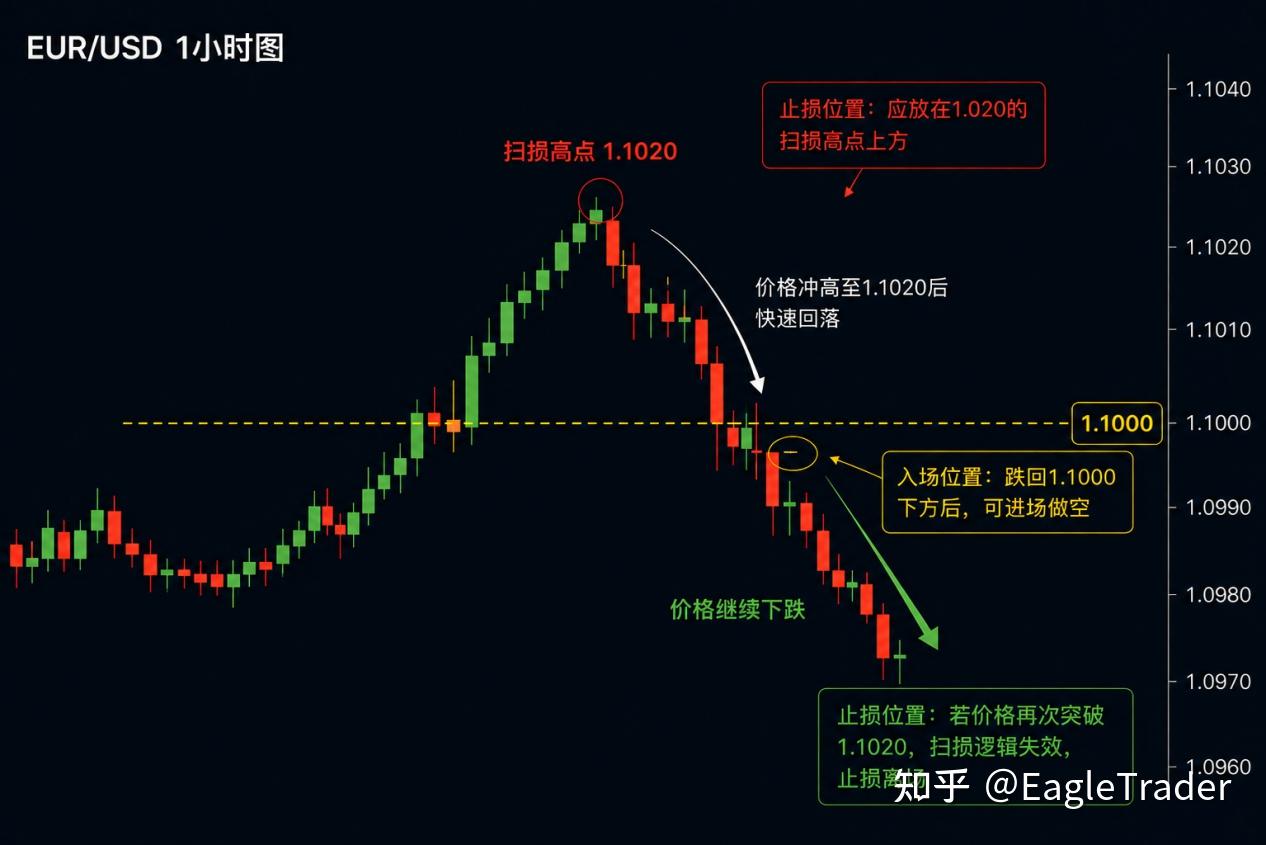
The underlying logic is very clear: if the price breaks through the high point formed by the loss sweep again, it means that the logic of “breakthrough failure” is no longer valid, and the original loss sweep judgment may be wrong. At this time, stopping the loss and leaving the market is a reasonable choice.
At the same time, it should be noted that the enlarged stop loss space does not mean that the risk can be ignored. Traders need to reversely adjust their positions based on the stop loss distance so that the risk of a single transaction is always controlled within the preset range – the goal of trading is not to never be stopped, but to keep the cost of mistakes under control.
The value of Stop Hunt has never been just to capture a reversal opportunity, but more importantly, to help traders establish a new way of thinking: from “predicting rises and falls” to “waiting for conditions to be met.”
In the face of key positions such as the previous high and the previous low, we no longer subjectively predict “this will definitely rise or fall”, but observe how the price breaks through, whether it can continue, and whether there is structural confirmation after the breakthrough fails, and then decide whether to enter the market.
This kind of trading idea of ”obeying the rules, not predicting, and controlling risks” is also the core ability that EagleTrader has always conveyed to traders: transforming vague market judgments into clear and executable trading rules, and continuously verifying and iteratively growing within clear risk boundaries.
Loss sweeping is just an entry point for trading cognition. Rules, execution and risk control are the core of long-term trading capabilities.