
Why isn’t your trading strategy able to amplify gains? Fund size may be the key factor
- 2026年7月17日
- Posted by: Eagletrader
- Category: News
In the trading market, many traders are used to paying attention to the strategy itself: Is the entry logic accurate? Is the winning rate high enough? Is the profit-loss ratio reasonable?
But in addition to trading methods, there is another factor that is often overlooked – strategy capacity (Capital Capacity).
To put it simply, different trading strategies do not have exactly the same requirements for capital size. Just because a set of trading methods can run stably under a certain account size does not mean that it can have the same effect on any fund size.
Account size often affects the execution method, risk control and final performance of the strategy.

Why do different strategies have different requirements for capital scale?
The operation of trading strategies is essentially a combination of capital management and trading logic. For some small position and high-frequency trading strategies, capital size may not be the main limiting factor. Traders are more concerned about execution speed, transaction costs, and market opportunities.
But for other strategies, the account size will directly affect whether the strategy can be executed as originally designed.
For example:
Trend trading usually requires a larger stop loss space to avoid short-term fluctuations affecting the overall judgment; the band strategy may need to wait for a longer period of market conditions, while managing positions by building positions in batches and taking profits in batches; a multi-variety allocation strategy requires sufficient funds to be allocated to different markets to reduce the impact of fluctuations in a single product. If the account size is limited, traders may not be able to execute the strategy as originally designed. In order to pursue returns, you may be forced to increase your position ratio; in order to control risks, you may not be able to fully participate in the market.
What is ultimately limited is not the trading logic itself, but the inability of the capital capacity to match the strategic needs.
<img alt="" src="https://www.hudianbaoseo.cn/uploads/allimg/20260717/1784256102367741.jpg" width="654" height = 436 If the account size is smaller, traders canWhether it can be carried out according to the original plan. And if you directly use larger personal funds to test, you need to bear higher trial and error costs.
Even if a trader has mature trading capabilities, before the strategy has been fully verified, a misjudgment may result in a large loss due to the excessive capital scale.
Therefore, for some traders, the real problem that needs to be solved is not whether there is a trading strategy, but how to find a capital environment suitable for verifying the strategy.
Proprietary trading provides a more suitable space for strategy verification
This is why the proprietary trading model has attracted more and more attention from traders in recent years. Compared with directly investing personal funds to test strategies, proprietary trading can provide a certain scale of simulated capital environment, allowing traders to verify their trading systems in real market conditions.
Traders can choose accounts of different sizes according to their own trading methods: small-scale accounts are used to test strategy execution; larger-scale accounts are used to verify fund management and position planning.
During the entire process, traders do not need to directly bear the risk of capital losses of the corresponding scale, but they can experience the changes in strategy execution effects under different capital capacities.
Of course, proprietary trading is not simply providing funds. During the assessment process, traders still need to face profit targets, maximum drawdowns, risk limits and other rule requirements, but these conditions can also help traders test whether their strategies have long-term execution capabilities.
Make the strategy more consistent with the capital scale
For traders who want to further improve their trading capabilities, finding the capital scale that suits them is an important step in improving the trading system.
EagleTrader Pro is based on this concept and provides traders with 5 simulated trading accounts ranging from US$10,000 to US$200,000.
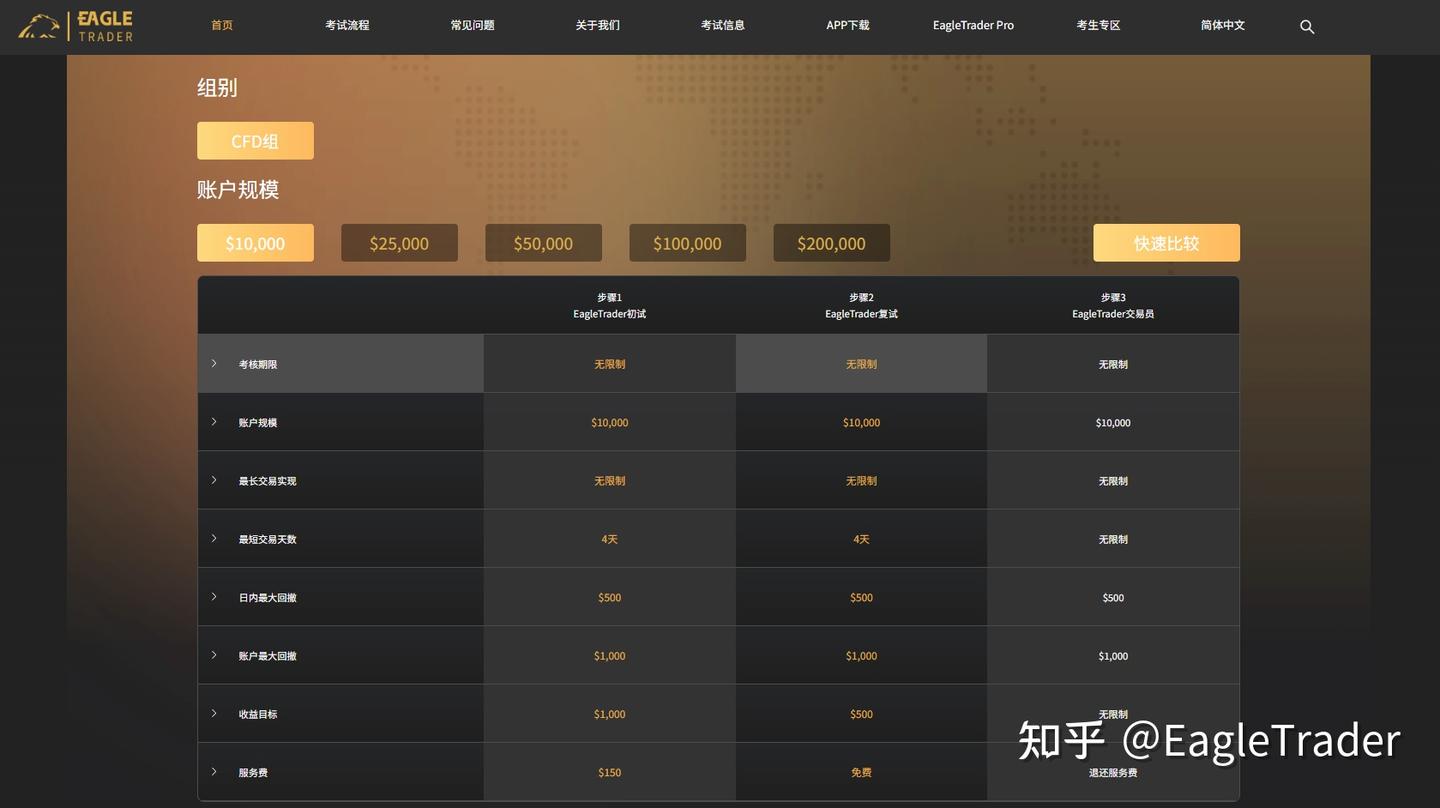
From challenge accounts of different sizes to gradually improving assessment stages, traders can choose a verification environment that is more suitable for them based on their own trading capabilities and strategy characteristics.
At the same time, through systematic assessment rules and strict evaluation processes, traders can further understand their risk control capabilities, fund management levels and strategy execution performance.
Whether a trading strategy is effective depends not only on the trading logic, but also on whether it is suitable for the current capital capacity. For some traders, proprietary trading provides a lower-cost method of verification, allowing traders to test their strategies in an account environment of different sizes while optimizing risk management and execution capabilities.
DangdiaoOnly by forming a matching relationship between trading strategy, capital scale and risk control can the trading system truly exert its due value.